


AVAILABILITY AND ACCESS: KEY TAKEAWAYS FROM THE NAIROBI SATELLITE EVENT
- Sarah Anderson

- 4 days ago
- 3 min read
Authors: Gerald Cheruiyot & Wanja Nyaga
Reviewed by: Sarah Anderson & Professor Shumone Ray
The Nairobi Satellite Event on Strengthening Food Systems, Nutrition & Health: Through Availability and Access addressed one of the most urgent global challenges — the persistent inequity in access to safe, affordable, and nutritious food. Despite significant advances in agricultural production, millions still face barriers driven by systemic, behavioural, and contextual factors.

By convening experts across nutrition science and behavioural economics, NNEdPro Global Institute for Food, Nutrition and Health and Busara Global aimed to translate innovative research into scalable, locally relevant strategies that strengthen food systems and advance their core mission: achieving nutrition security through education, innovation, and cross-sector collaboration.
Integrating Local Knowledge into Global Nutrition Policy
The event began by highlighting the importance of systemic thinking. Professor Sumantra Ray (NNEdPro) emphasised that resilient systems in global health policy depend on integrating nutrition education. Food system stability goes beyond production; it demands consistent, equitable access to diverse, nutritious diets, especially during disruptions.
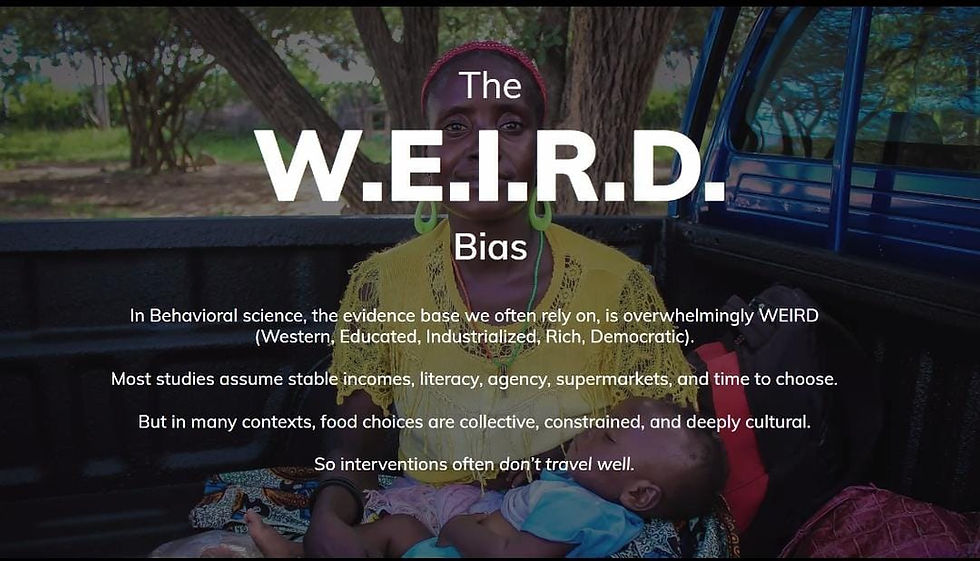
Following this, Juhi Jain (Busara) critically addressed the constraints of applying research derived from WEIRD (Western, Educated, Industrialised, Rich, and Democratic) contexts to diverse global populations. She argued persuasively that for any intervention to achieve sustained impact and scalability, it must be meticulously grounded in an empirical understanding of local social, cultural, and economic determinants, thereby maximising relevance and implementation efficacy.
Behavioural Science: Translating Knowledge into Dietary Action
A core focus was placed on the translational potential of behavioural science in improving dietary quality. Wanja Nyaga (NNEdPro) investigated the crucial need for behavioural change interventions specifically designed to shift negative consumer perceptions surrounding traditional foods. These indigenous crops are often superior in terms of micronutrient profiles and environmental adaptation, yet face persistent marginalisation. The proposed intervention strategy involves leveraging behavioural insights to reframe these foods as economically viable and culturally desirable choices, thereby addressing both food availability and acceptance.
Complementing this, Wairimu Muthike (Busara) outlined a structured behavioural design approach to enhance food system resilience through the Bridging of Knowledge Systems. This approach advocates for the systematic integration of formal scientific evidence with the invaluable knowledge pools of Indigenous and local communities. By applying analytical and design principles, researchers can construct policy and communication frameworks that are simultaneously evidence-based and culturally resonant, significantly enhancing the efficacy of access interventions.

Actionable Interventions: Waste Mitigation and Cross-Sectoral Equity
The final segment transitioned into highly translational insights applicable at the market level. Fadila Jumare (Busara) presented data on the effectiveness of behavioural approaches to food waste prevention in traditional markets. She demonstrated that targeted, empirical 'nudges', such as optimising product display ergonomics, introducing clear informational prompts, or training vendors on loss mitigation techniques, can lead to quantifiable reductions in food loss. This directly translates into an improved effective food supply and enhanced market efficiency.
Bringing the discussion to a close, Dr Kathy Martyn (Brighton University) employed the powerful ‘Planting Seeds’ framework. This highlights the need for deep-rooted, collaborative, and sustainable engagement across all sectors to ensure equitable access to good food. The argument centred on the ethical and practical imperatives for academia, policymakers, civil society, and the private sector to pool resources and expertise, ensuring that nutritional security is achieved globally as a fundamental right.
A Unified, Evidence-Based Pathway
The Nairobi Satellite Event unequivocally demonstrated that meaningful progress in global food systems requires moving past traditional silos. It mandates a sophisticated, unified model that strategically merges the scientific rigour of nutritional security (NNEdPro) with the deep human insights afforded by behavioural economics (Busara). This robust, context-sensitive framework establishes a clear and actionable trajectory for building truly resilient food systems that secure health and equitable dietary access for populations across the globe.

The event concluded with closing remarks that looked forward to exploring the potent synergies between Busara’s expertise in behavioural science in the Global South and NNEdPro’s mission in nutrition education and research. This partnership itself stands as a model for the kind of cross-sectoral partnership the event championed.
In summary, the Nairobi Satellite Event did not offer a single silver bullet. Instead, it provided a sophisticated and interconnected toolkit. The interactive discussions that followed generated valuable insights across several domains:
Equity must remain central. Structural disparities: geographical, economic, and gender-based, continue to shape who can benefit from improvements in availability and access.
Data-driven decisions are essential for designing interventions that are responsive to local conditions and capable of evolving as contexts change.
Community co-design strengthens the relevance and sustainability of interventions by grounding them in lived experience.
Intersectoral coordination ensures that food system reforms address the breadth of challenges affecting nutrition security.
Scalability and feasibility should underpin innovation, ensuring that tools and strategies can be realistically implemented within existing resource and infrastructure constraints.
By viewing availability and access through this multifaceted lens, the event made a significant contribution to the global dialogue, reminding us that the journey to a nourished world is as much about human behaviour as it is about agricultural yield.


Comments